A HISTORY OF ALTERNATIVE ROCK ONE ALBUM AT A TIME: (1977-2001) ALBUM 3-25: “THE SPECIALS BY THE SPECIALS” (1979

The Specials UK

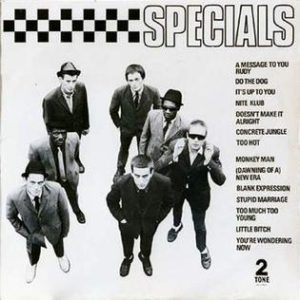
f you weren’t British or a self-defined Rude Boy (or even knew what that meant) in the years of Thatcher’s England, The Specials were more spirit than form, a band name whispered into the wind who imbued more music than they ever made themselves. The original members were only together for two records–Their self-titled debut (our topic for today) in 1979 and the follow-up “More Specials.” in 1981. The band that lasted barely 4 years and self-destructed before most of the members turned 30 would nonetheless be responsible for the bands Fun Boy Three and General Public and indirectly The Lightning Seeds and Rock N Roll Hall of Fame Class of 2023 nominees The Eurythmics. At the intersection of Ska, Punk and New Wave, the roads leading on from the Specials ended up being more special than the band themselves.

The Specials (the record) feels like an album born of youth, effortless and uneven, conviction in place of completion. It’s considered a pioneering record of early British Ska, whatever that means to you (to me it means you can’t listen to it without raising one knee then the other, an involuntary marching band of one). You’ll also hear that Britain is a racist, crumbling pile burying its young while you groove. How fun! 

But it is.

At 15 songs, a good half feel curiously undone, as if keyboardist/label owner/primary songwriter Jerry Dammers yelled “good enough” before he should have. The ones we remember are gemlike in their imperfections: the understated battle cry of “A Message to you Rudy” , the metallic soar of “It’s Up to You” and my favorite “Concrete Jungle” which sounds as though The Stooges and Death met up on a Detroit street corner one Sunday morning to reinterpret Toni Basil’s “Mickey,” as a painful tale of youth violence.

As a young person near Detroit at this time, I knew The Specials from T-shirts and posters in record store windows. I didn’t know what “ska” meant until age 18 and the bands that operate in that genre I do know are American interpreters of what The Specials brought to bear. It’s my own fault for not looking more into where they came from and therefore voting without meaning to with the category’s most ignorant critics: That Ska is a spasm fad at 10-year cycles when white kids feel like dancing while wearing mid-century costumes and don’t want to learn steps like you have to in swing dancing.

I really like to dance. So any genre whose prime directive is lifting your knees in rhythm can count me in.


The Specials: Briefly here, then back again with an echo echo echo. Too young to be mods and too old to be New Wavers, they still made the nodes between those two generations of British youth culture bright and clear. Multiply that by the band punching then countering with Ska then Punk then children-of-Windrush Caribbean party music, and you have a band that made different shades of British Youth Culture feel of a common spirit and precisely the time nationalist politics sought to divide and tear.

I’m so glad I listened and made their spirits feel real.

Hits: 

“A Message to you Rudy”

“It’s Up to You”

“Concrete Jungle” 

“Little Bitch”

“You’re Wondering Now”

Misses: 

“Do the Dog”

“Too Hot”
“(Dawning of A) New Era”

Listen to This: 50 Songs I heard for the first time in 2017

Welcome to the The Smokler 50: 2017 Edition.

The idea: 50 songs I heard for the first time this year. Doesn't have to be new just new to me.

How to: Best if you listen in order as they are sequenced in a certain way. If you don't like a song, skip it.

The point:  Discover 3 songs you now like that you didn't know before listening. If you listen and say "wow, you like a lot of different types of music!" I have succeeded. If you say "Wow you like 70s Irish punk" or something like that, I have failed.

Enjoy!

The playlist is also available on Youtube


50 Songs Kevin Discovered in 2014…


Each January I make a playlist of 50 songs I  discovered that year. They can be from any genre and any time in music history with only prerequisite that I first heard them in that calendar year.

Usually I "discover" around 600 new songs. I'd like to share my 50 favorite from 2014 with you. 

Playlists for 21032012 if you're curious or inclined.

You can hear them on the playlist window above. And I'd love to hear about your favorites/least favorites when you're done. 

How to Attend a Music Festival if You’re over age 30

I’ve never believed music festivals are just for the zealots, young punks who have to mash themselves against the lip of the stage or dress in “festival fashions”. Festivals are for all of us who love music, love it enough to want to be there as its happening, even if being there gives us sore feet and headaches more than it used to. Multi-act festivals are inherently more democratic than single-acts shows. As long as you love music, you’re invited. But if 9 hours of standing up amid the elements is a bit intimidating, that’s fine. You just have to be a little bit squarer, a little more prepared, a grownup about it. So you can have as much fun as the kids.

I’ve put together what I’ve called a Mix-Tape of preparedness. Listen. Then rock on.

 Side 1: Before

I. Communicate Expectations. You’re probably going to this festival with someone else. Unless that someone else is a cyborg duplicate, you and your pals will not all want to see the same acts. At a mid-sized festival (think 30-50 bands at an Outside Lands, a Lollapalooza or Bonnaroo) it’s highly unlikely. At a giant festival (The “world’s largest music festival” Milwaukee’s Summerfest had 700 bands last year. SXSW Music had nearly 3 times that many), it’s a mathematical impossibility. And whatever their taste, your friends reasons for attending will be at least somewhat different than yours too. 

 So who are these good people and how do they approach such things? Do they like to stay all day or see three acts and go home? Are they looking for a sampler platter of music or a binge on one genre? Do they have a must-see band or are they mostly along for the experience? Remember the advantage of being a bit older is that you and your friends have some experience to fall back on, some war stories about great shows and one’s you just as soon forget.

Have a pre-conference jawbone with coffee, or booze or my choice, lavish desserts. Ask about everyone’s skin in the game and don’t be afraid to show your own.

Now having a meeting about concert going might sound about as hip as bringing a life jacket to a waterpark. But believe me, this meeting thing is about maximizing fun and not throwing a wet blanket over it. Showing up with everyone wanting different things is asking for an argument midday with everyone running off in different directions. Which sucks. Then why did you go together at all?

II. Listen. Prep.

We’ve been around enough to know that festival going ain’t just about seeing your favorite bands but discovering new favorites too. We also know that going in cold may be the easiest but not best way to do that. We music junkies are already hooked up six ways from yesterday to streaming services, music blogs, favorite radio programs. We’ve got two raised-fistfuls of ways to discover new music without ever leaving the house. Doing the same with 300$ festival tickets and a weekend of your life is lighting birthday candles with a flamethrower.

Read the festival lineup. Make a quick three column list of must-sees, could sees and never-heard-of-em’s. Compare it with your friends lists. Now take your “don’t knows” and their “must sees”, plug them into the online music service of your choice and listen. Give an artist two songs and pass judgement. Now redo your lists, based on what you’ve heard. There’s your potential new favorites list, ready and waiting.

III. Compare Notes.

 Any festival worth its hype has a place on its website to create your ideal schedule and share it with a friend. Do this with your friends and bring it to the meeting. Show them your schedule and include when you’d like to arrive, leave and eat meals. Again, not very “rock n roll” right? But is isn’t any more "rock n’ roll" going to a great set of shows and only remembering how hungry or tired you were and wondering where the hell the john was. A little planning gets rid of distractions and lets you focus on the music. And face facts. We aren’t 19 anymore. Our body and its stupid complaints are more distracting than they should be.

IV. Weed out.

Not the green, fragrant kind (we’ll get to that) but the process of elimination. Every festival has its own set of physical conditions (outside/inside, raucous/intimate) and some bands just aren’t suited to them. You aren’t doing yourself as a fan or them as an artist any favors seeing them at a show where their music has to battle circumstance. So skip the solo guy playing the guitar at the giant summer outdoor stage or the 19-piece afro-percussion band inside the 900 square foot club with tin walls. If the musicians are any good and you don’t live in the middle of nowhere, they’ll be back around soon and you can see them where the music, not the setting, is primary.


Side 2: At the festival


I. Suiting up. Each of us is old enough to  probably remember the pre-giant music festival days where the only entertainment were the bands. Nowadays, a festival is a event unto itself where the audience are just as much a part of the show. Which means you might feel tempted to dress in something fun even outrageous, befitting the occasion.

To which I say “enjoy” but don’t feel like you must. Much more important are comfortable shoes (see “Standing Up. Hours of it.”), layers to get warmer/cooler, a small over- the-shoulder-bag for water, earplugs, keys, flask, bus pass etc. Think of fashion here as utilitarian first. Wear a papel robe if you'll have a better time doing it. Otherwise, you want to focus on the music. And clothes that make you uncomfortable are a distracting pain in the rear. 

III. Easy on the booze. Off the drugs. None of us just fell off the the 10th grade turnip truck. We’d had the “I got bombed at that show” experience 100 times and no one is impressed with those stories anymore. A 22 year old knackered at a concert is be expected. A grown adult with a job and two nickels of dignity to rub together is pathetic.

Put the shit down. Have a few drinks, a hit of whatever. But no more than a normal weekend’s amount because you’ve probably been excited about this festival for months now making it the furthest thing from a normal weekend.

Then why not celebrate you say? Use your head. You really need to juice up dozens of bands, thousands of people, something as amazing as a music festival with MORE STIMULATION? Then you’re an ADD kindergardener and let me suggest a weekend detox with Yo Gabba Gabba. On mute. In the dark.

V. Sit down if you need to.

Yes, really. No one cares. No one is going to give you a not-rocking-out demerit. We are years past the point of anyone’s “cred” being in question? What are your friends doing this weekend? Putting up storm windows? 

VI. Communicate. Repeating from Side 1. Honest communication makes for good festival going. If you’re tired, say so. If you’re hungry, tell your friends and go eat. Don’t whine of course but also don’t think that not listening to your body is being a good sport or a more dedicated fan. It’s stupid. You’ll be in much better shape to do all of that if your body isn’t yelling at you. And you’ll be a better festival buddy if you’re on acting like passive aggressive by not saying what you need.

That includes going home. When you’re done or feeling like the end is coming, say so. Then discuss. And keep right at the front of your mind that music is eternal and wonderful and everything great in life but so is friendship. Don’t knock over one for the other. 

Bonus Tracks:

I.   Day after. You’ll probably be sore and tired. I wouldn’t book time at the gym, a day at the playground with your kids or plan to work late. Think of it as the day after a long flight. Go as easy as you can.

II. Follow-up. I love this part almost as much as the festival itself. If you heard anything you liked at this festival you liked, download some tracks immediately, book time at the nearest record store and put your discoveries in regular listening rotation. That way for at least a week or so, every time you fire up your music library, you’re reminded of the fun you had the festival. The festival then has a comet tail. It’s a complete waste to spent all this time and money and energy planning, getting excited and attending something that you, effectively, forget right after its over.

You’re going to be tired, no doubt. But hopefully tired and happy and ready to share in your joy. Upload your photos and share them. Tell a few friends about the great new bands you experience. Make what you experienced part of your life instead of a memory. Which, hey, is why we love music so much to begin with.  

Classical Music and Cinema: Mozart and ‘Trading Places’

Location isn't usually important in film comedies the way say, Los Angels is vital to dramas like Chinatown or Chicago to action-thrillers like The Fugitive. Comedies trade in laughs and laughs come from people and situations and animals with digestive ailments. Places don't crack us up. 

Then why do I never forget that one of my favorite comedies–Trading Places (1983)–takes place in Philadelphia? We can thank its unforgettable opening flipbook of the city's icons next to images of ordinary people going to work and the city's poor not having any. The montage is set to Mozart's 'Overture to the Mariage of Figarro,' which we've heard a million times but never quite like this–as an argument for the artistry of comedy rather than an affirmation of its frivolity. Listening to Mozart does not make you smarter. But in Trading Places, Director John Landis and his composer (the legendary Elmer Bernstein) use Mozart as a shorthand reminder that comedies need not make you dumber either. 

The plot of Trading Places has been called a modern update of Mark Twain's "Prince and the Pauper." A rich stuffed shirt (Dan Aykroyd) and a street hustler (Eddie Murphy) are made to switch social places by Ackroyd's conniving uncles who like to conduct social experiments of such things. When the two uncover the uncles' sneaky plan to game the commodities market, they strike first, beating them at their own scam and getting rich in the process. It being the early 1980s, defeating old, inherited money through fleet footed stock trading was seen as the rebellion of youth, blows against the empire, a victory for tweed over eh, tweed. 

Trading Places did great with critics and has endured mostly because its a fantastic silly comedy (SNL veterans Ackroyd and Murphy and a sequence with a horny gorilla made sure of that) that doesn't scrimp on the fundamentals. The supporting cast bench–Jamie Lee Curtis, Ralph Bellmany, Don Ameche and Denholm Elliott–is embarrassingly deep. The script has nary a wasted line. And hiring Elmer Bernstein to score a summer comedy is like hiring Steve Jobs to oversee the launch of a lemonade stand. 

It's in his choice of Mozart to open the film that we see that Landis is up to more than talent overkill. Once you've seen the film (and have a modest knowledge of opera) the choice of 'Overture' is a cheap gold star for the viewer. 'Figarro' is a comic morality play about a servant outwitting an aristocrat, a nod at Trading Places's gentle theme of money not equalling intelligence or even refinement. But one level deeper is Landis's bigger goal: an unsmiling reminder that comedy has as gloried a cultural history as classical music and the grandparents of Trading Places are not pratfall artists and music hall crass but  great cinematic comedians like Billy Wilder and Ernst Lubitsch from a generation before. 

Of John Landis's first 10 films (1977-1988) 6 can fairly be called classics. One (National Lampoon's Animal House) is in the Library of Congress, an honor also held by his contemporary Harold Ramis (Groundhog Day). Throw in the best work of Ivan Reitman from that time (Stripes, Ghostbusters) and you have a body of comedy movies that not only crack you up but used legendary composers who created memorable themes, made room for 40-year veterans in the supporting cast and had stars that later were nominated for Oscars and had 20-30-year careers ahead of them.

This was broad comedy given the time, care and resources of high art. I've no idea if in hindsight we'll regard contemporary laugh factories like the work of Judd Apatow and the Frat Pack the same. I tend to doubt it. 

Musically speaking Trading Places starts big with an iconic Mozart piece. Afterward, Bernstein's score is restrained and sober. There's no lining the atmosphere with pop songs that would dominate the later years of the decade and few memorable musical passages beyond the opening. Mozart is what we're supposed to remember, its inclusion a wink without a smile. Its as though opening a comedy with more than enough fart jokes and gratuitious nudity with the ultimate icon of high culture was a way of saying "Pay attention. What we're doing here has the same craftmansmenship and dedication as when young Wolfgang sat down at the piano." 


Music Monday: Willie Nile.

Willie+Nile+willienile8

I discovered Buffalo, NY's Willie Nile when a track of his called "Best Friends Money can Buy" appeared on a Paste Magazine compilation a few years ago. I liked the jangle, the crisp, singalong chorus, the falling-water harmonies backed by a scruffed-boot guitar. He reminded me very much of Marshall Crenshaw, another singer/songwriter I like a great deal. Both seem heavily influenced by the Byrds (choral harmonies, crystalline melodies) but have also spent some time with music by black people. The vocals here are a shouty gospel instead of technical perfect college a capella band.

Nile (real name Robert Anthony Noonan) is a slow but consistant musican, releasing seven studio albums since his debut in 1980. That self-titled debut is apparently caught up in some record label shenanigans since its both the most highly regarded of Nile's work and not available digitally anywhere. 

Since I already own it on vinyl, I just torrented the thing. I give you permission to do the same.

In the meantime (or before your conscience kicks in) I'd go to YouTube and give the leadoff track "Vagabond Moon" a listen. It'll give you a sense of what the man can do and if you can flow with it. If so, I'd jump straight to his 2004 album "Beautiful Wreck of the World," which is available just about anywhere your mouse will take you.

Classical Music and Cinema: Wagner and Apocalypse Now

I'm going to be writing occasional short pieces on classical music in cinema for Salon97.org. The first one explores the use of Wagner's "Ride of the Valkyries" in Francis Coppola's Apocalypse Now.


In his 1979 review of Apocalypse Now, Roger Ebert called the scene above “simply the greatest movie battle scene ever filmed.” I’m with him on that one and not because of its pacing, photography or that you could watch it 15 times in a row and not bore once. Try muting the sound and it’s still great cinema. Now turn it back up and the music takes a great battle scene and gives it another life–as historical double entendre and a microcosm for the film’s thoughts on war itself. In a hail of strings we all recognize, the triumphant arrival of our military becomes a ironic anti-climax, a white horse dragging a chariot piled with corpses.

Full post at Salon97.org

We Journey Fans Never Stopped Believin’…

So yesterday I heard that Journey’s "Don’t Stop Believin’" is the most downloaded catalog song on iTunes. Sources speculate that the song has received added boots from a) Being the victory song of the 2005 World Champion Chicago White Sox and b) the music choice for the closing scene of the series finale of "The Sopranos."

My opinion? Because it is perhaps the greatest singalong rock song in history, that’s why. Its 27 years old and still as joyous, fun and triumphant as ever. And have you ever heard a piano opening that wonderful. No, you haven’t. There isn’t one.

Journey gets a lot of hate. They’re silly, they’re lame, they’ve got bad hair, they beat up my girlfriend, whatever. You don’t like DSB, the fault lies with you. The proof is in the numbers, haters. I say suck it.

And now we sing.

Classical Music as Punishment?

The Associated Press reports that a judge has sentenced a hip-hop fan, cited for paying said music too loudly, to a 150$ fine or 20 hours of listening to Bach and Beethoven.

Andrew Vactor, 24, lasted only about 15 minutes, a probation officer said.

It wasn’t the music, Vactor said, he just needed to be at practice with the rest of the Urbana University basketball team.

"I didn’t have the time to deal with that," he said. "I just decided to pay the fine."

So it probably wasn’t the music itself but being forced to sit and do anything against your will for 20 hours–even eat chocolate, pet kittens or deflower virgins–probably gets old fast.

It did compel me to ask however…

What would be my own sonic torture?

No one musical genre offends me enough that i couldn’t hack 20 hours of it (blues isn’t my favorite, say. But after a day’s worth, I’d probably don a somber expression and a twelve-bar scale my damn self). My issue is sound quality not sound type.  Even my favorites played at a screeching volume or through static would drive me batty after maybe 15 minutes.

What is the soundtrack to your musical nightmare? Lay it on me down below.

One More Time: Like Seeing God

I can’t quite put my finger on why but I find this video indescribably moving. I wasn’t there. The lyrics hardly stirr my soul. Its as best a catchy dance number. Then why does it make me tear up?

Maybe it’s the unity of spirit, how everyone seems be giving and receiving, the band the music, the crowd their excitement and how the two compound each other. Maybe it’s as simple as the dorky way one of the member of Daft Punk claps his hands as the song opens (as if that’s necessary. The song is already 90% beat). Maybe there’s something quasi-revival tent about the proceedings, which the gaudy lighting and the arms thrust upward of the audience.

Or maybe I just have a week spot for "Let’s throw a worldwide party" songs (See Madonna’s "Holiday" or Kool and the Gang’s "Celebration"). That’s a muxtape in the making.

Not sure. But God, would I love to see this band live sometime. It looks better than chocolate.

OUT NOW: Break The Frame: Conversations with Women Filmmakers
NOW AVAILABLE