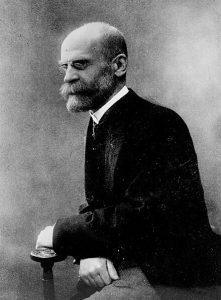
Occasionally I am asked for advice on productivity and how not to let your mistakes get in your way. I often answer with Emile Durkeim.
Who? And why?
Emile Durkeim was French Jewish sociologist in the 19th century, the father of modern criminology and a hero of mine. Why is directly relevant to our mistakes and sense of embarassment and shame around them.
Durkeim gave us two very important ideas (among many). 1) That crime is the problem of society and not just individuals 2) that problems are value neutral. They are simply there to be fixed. It does not mean our feelings about them are unimportant just that we work better if we view something we do badly (aka the problem) as say, a leaky faucet rather than a character flaw. It’s easy to fix a leaky faucet if you don’t get caught up in what having a leaky faucet says about you as a person.
Crime therefore, is not the failing of individuals but a checklist of what society can do better. And fixes are value neutral.
Therefore, not being able to say, get to work on time says nothing bad about you as a person. It is a leaky faucet ready to be tightened. So tighten it, be proud you are the person who saw the leaky faucet and fixed it. But let go of the fact that it is leaking. Faucets leak sometime. That is life not you not being able to do life.
A place I have visited for business and pleasure for 14 years.
Yeah, it’s got Mitch McConnell and his desperate hold on meaningless power but he ain’t what Louisville is all about. LV has an embarrassment of riches when it comes to with open-minded, creative, diverse, forward thinking people and institutions like the Speed Art Museum and movie theater, Carmichael’s Bookstore, one of the great neighborhood bookshops in America, Please and Thank You coffee (creators of the nation’s finest chocolate chip cookie) the 21c Hotel chain, which has a free art museum in each hotel for guests and non guests alike, a killer public library system, a sublime public radio station in WUOL and Headliners, a live music venue everyone in the world should visit when we can.
Fellow blue staters, as I spoke of Tulsa previously, do not clutch your pearls when you hear “Kentucky” and think everywhere in the Bluegrass State lives in a dirt shack out of a Walker Evans photo. Louisville is one of America’s great cities. You are really missing out on something if you do not drop by.
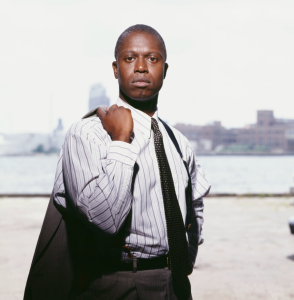
Though the competition is stiff, though the choices are many, when it comes right down to it, is there a better television cop show than HOMICIDE: LIFE ON THE STREET? (1993-1999). And was there a more compelling character on it than Detective Frank Pembleton, played by the late, great Andre Braugher who died earlier this month?
The answer is no. If you only know Mr. Braugher’s work via Brooklyn 99, it was the character of Frank Pembleton that laid the seedbeds in which Captain Ray Holt could flourish. If you first became familiar with TV Showrunner David Simon’s work via THE WIRE (2002-2008) Mr. Simon’s first attempt at using television to explore how cities work and often fail and the all too human people in the all too difficult jobs assigned to those roles was HOMICIDE. HOMICIDE was really a show about a profession, who choses to take on the impossible work of speaking for the dead, how the work can corrode your soul and yet a soul made of stainless steel is an absolute prerequisite for the job.
In a show full of top drawer actors (I still cannot believe that Richard Belzer, Ned Beatty and Yaphet Kotto are gone too. Thankfully future Oscar winner Melissa Leo is still here) no one did better at embodying the conflict of a noble yet impossible calling than Andre Braugher. In his last season, he would win an Emmy for it. But that’s only a cake topper. Frank Pembleton will live forever as one of the most unforgettable characters in the history of television.
I was fortunate to live in Baltimore while HOMICIDE was being filmed there and to witness Andre Braugher at work.
Sail on, Mr. Braugher. Thank you for the memories, the great work, the still-emitting glory of your artistry and the reminder of how hard and necessary it is to speak for those who cannot speak for themselves.
It was our privilege and honor to visit the Emanuel African Methodist Church (known as Mother Emanuel) in Charleston, South Carolina on our first visit to the city this fall. Standing on the sidewalk just to the left of its front door, I found myself so overcome I asked my wife if I could give something like a drash (Hebrew for sermon or textual interpretation) right there.
She listened and this is what I said.
“We are standing now in front of one of the most important structures in America, a house of worship where, for over a century, we have entered the struggle over what it means to be an American, what promises were made at our founding and what promises were broken. That struggle all so often is really an attempt to insist on the repair of those broken promises.
At times, right here, that struggle has been in victory, like when this congregation and this church were at the center of freedom struggles during both the Civil War and the Civil Rights Movement. And at times it has been in horrific defeat as it was that Wednesday Night in June right here, only 8 years ago.
On that evening, 9 members of the the staff and congregation of Mother Emanuel gave their lives for a principle so important to whom we are as a nation that it is in our very first Amendment, the freedom to worship and the freedom to gather. They invited a nervous stranger to join them in prayer on the idea that a house of worship here in America does not close its doors to anybody. And they paid for their patriotism with their lives.
As much as we have to take in the full horror of that evening and of the senseless loss of those 9 precious Americans, we can look up at this beautiful building and say that whatever misbegotten evil Dylan Roof thought he was carrying out, he failed. Pathetically so.
At best, Dylan Roof will spend the remainder of his meaningless waste of a life in a dark cold cell. And while he does, at 110 Calhoun St in the city Dylan Roof wished he had grown up, stands Mother Emanuel, tall, proud, gleaming white against a cloudless autumn sky. Still serving this community, still ministering to the sick and desperate, still a pillar of Charleston, this pillar of the confederacy, still led by this city’s black citizenry and still reminding the rest of us, from near and from far who have come to pay our respects of what it truly means to be an American.
We are honored and humbled to be here. And we thank them for having us.”
None of us buying our first Radiohead T-shirts could have known that, three decades later, we would be living in the world Casey Kasem helped create. It is the music fan's time, powered by self-curation and the urge to share. Our playlists, queues, devices and social media profiles may be as unique to each of us as our genetic code. But sharing and effusing are the highways this data travels. Since those highways are choked with music already, we search in the noise not just for experts but also for common ground, not just for someone who knows music better than us but someone who feels as enthusiastic about sharing the joy of it as we do.
In an earlier time, we would find our musical brothers and sisters by picking a side — alternative over mainstream, rap instead of rock — seeing who agreed, then defending our choice to the death. In the 21st century, that feels like hating on hugs and world peace. We like the music we like. Instead of xenophobes, we are now all world travelers, on the same journey to find more.
"Here on the pulse of this new day You may have the grace to look up and out And into your sister's eyes, Into your brother's face, your country And say simply Very simply With hope Good morning."
I was on the Washington Mall that clear January in 1992, 19 years old, having voted in my first election the November before, when Dr. Maya Angelou read her poem "On the Pulse of Morning" for the inauguration of President Clinton. I will never forget that day, standing there in the freezing cold, with my mother and youngest brother, seeing a speck of a tall African-American woman in the distance speak of the new president and the America we all came from and was dawning that morning.
I thought of how my mother had marched for civil rights and the rights of women, how my father had welcomed the black friends of my brothers and I to our Passover Seder table then insisted on hearing about their families, their traditions and how my late grandfather, at risk of reprisal, loss of business and professional standing, had given good paying jobs and no interest loans to the African-American men who worked on his construction crews, simply because it was the right thing to do.
And I looked at that tall woman in the distance, whose voice and words rolls from the steps of our capitol, like thunder rolling down the mountains. I knew that woman's personal history meant she had every reason and cause to be bitter and disgusted with the country of her birth, the country that broke its promise to her and generations like her.
And I heard her say it was our country, all of us, and at its root was not the promise to get it right the first time, to try and do it better next time, with year, each election, each generation. That to be an American was to believe, fundamentally, that from night always came morning.
I will miss you, Maya Angelou. You were the guiding spirit of one of my proudest days as an American.
I am terribly sad today. Which on the face of it makes very little sense as I did not know Steve Jobs, enjoyed but did not worship his company's products. He wasn't even a very nice person and I have little patience or time for not-nice people.
But Steve Jobs represented much of what I value most in the world, much that I try my own life upon–innovation, creativity, usefulness and the power of dreams. He also was an incredible showman in an industry that believed that aesthetics, flair, hell even joy were afterthoughts. Computers were supposed to work, to do things, to solve problems. They were not supposed to be fun.
Heck with that, said Steve Jobs. He loved computers, loved technology, and saw their potential in all of our lives, not just those who went to MIT or could program. He wanted to share that love with all of us. Yes, he wanted to make a pile of money too but that never seemed to interest him that much. He wore the same clothes everyday, bought two giant fancy houses and never moved into them. He was worth nearly $8 billion but how many times did you read about his hot air balloon races, his antique car collections or other wild excesses?
Never. There weren't any. Mr. Jobs wanted everyone in the world to have great technology. Business is the fastest most efficient way to make that happen.
I'm an Apple enthusiast as I sumply haven't found a better alternative to living as a citizen of the 21st century than with the iPhone, iPod and Macbook Pro. Those are the tools of my trade. And yes, someone could design better ones someday. But they haven't and probably won't. As magnetic as Steve Jobs is, his competetitors simply don't believe that values like fun, humor, and beauty belong to technology. They are wrong.
My favorite Steve Jobs moment is the video above. it's 1984 and he is announcing the Apple Macintosh. He is not quite 30 and the computer he's about to unveil will change the world. But he's already done it once with its predeccesor, the Apple II.
He will flip our lives over at least 5 more times in the course of his, with the Laptop, iPod, Pixar, iPhone, and iPad. He will bring the world's attention to Northern California as the center of innovation and entrepreneurship. He will also do it after getting booted out of Apple then returning, as perhaps the greatest second chapter in the history of American business.
And yet here, all of that is yet to come. He is young, handsome, a bit cocky and yet at heart, still a nerd. The "Chariots of Fire" theme he used was 2 year past its sell date by then. And yet it works as it implied speed, triumph, going for it, despite obstacles, despite it seeming crazy. It means tomorrow, as F. Scott Fitzgerald called tomorrow.
"Tomorrow we will run faster, stretch out our arms faurther…"
Fitzgerald also said most American lives have no second acts. He died in his early 40s having drunk himself into the grave, convinced he was a failure. Steve Jobs spent the last 10 years of life with a terrible illnes and pushed on anyway. He figured he had one of two more revolutions left in him so why not? And then he changed the world with the iPhone. And again with the iPad.
Steve Jobs had a second act, then a third then several more. He was lucky enough to know what he wanted to do early in life and he then pushed it and pushed it again for all it was worth. Most of us are not so lucky and fall into rather than know our life's mission. But when we find it, go for it, Mr. Jobs said. Run faster, stretch out your arms further.
Your heart and your intuition already know what you are supposed to become.
Yesterday and today, there are flowers, candles, tributes being left in front of Apple Stores around the world. One I saw had a cardboard sign, attached to a storebought boquet. The sign read "Keep Thinking Different".
For a CEO, a businessman. Normally we see these commemorations for artists and heads of state. But it would be wrong to see this as strange.
We do this for our heroes. For people that inspire us to be more than we thought we could. Who saw the world as bigger than we did.
When Leonard Bernstein died in 1990, his funeral procession drove through the streets of Brooklyn where he was born. A group of construction workers stopped working, removed their hard hats and waved. "Goodbye Lenny", they said.
Maybe they said it because they thought Bernstein one of them. Maybe they were classical music fans or maybe Bernstein had converted them. I think they related to him, as the son of small businessmen who accomplished something great. But they thought him one of their own because he shared the thing he created. He didn't horde away the thing he loved. He devoted his life to making it more fun, to filling it with joy.
Steve Jobs did that with wires and microchips. He helped the entire world believe that the future was coming, maybe already here and it would be wondrous, exciting, creative. Fun.
And it belong to each of us. Each of us with dreams and the willingness to chase them. Chase them fast.
I heard the news of Steve Jobs's passing and sat down to write. Its the only kind of creativity I know. And I do not have time to waste not working at it.
That you for our future, Mr.Jobs. We will do our best with it.
"The victims of the violence are black and white, rich and poor,
young and old, famous and unknown. They are, most important of all,
human beings whom other human beings loved and needed. No one – no
matter where he lives or what he does – can be certain who will suffer
from some senseless act of bloodshed. And yet it goes on and on and on
in this country of ours.
Why? What has violence ever
accomplished? What has it ever created? No martyr's cause has ever been
stilled by an assassin's bullet.
No wrongs have ever been
righted by riots and civil disorders. A sniper is only a coward, not a
hero; and an uncontrolled, uncontrollable mob is only the voice of
madness, not the voice of reason.
Whenever any American's
life is taken by another American unnecessarily – whether it is done in
the name of the law or in the defiance of the law, by one man or a
gang, in cold blood or in passion, in an attack of violence or in
response to violence – whenever we tear at the fabric of the life which
another man has painfully and clumsily woven for himself and his
children, the whole nation is degraded.
…Too often we honor swagger and bluster and wielders of force; too
often we excuse those who are willing to build their own lives on the
shattered dreams of others. Some Americans who preach non-violence
abroad fail to practice it here at home. Some who accuse others of
inciting riots have by their own conduct invited them.
Some
look for scapegoats, others look for conspiracies, but this much is
clear: violence breeds violence, repression brings retaliation, and
only a cleansing of our whole society can remove this sickness from our
soul."
I'm been talking some crazy jibberish for at least ten years about what a genius MN is, what a gift she is to contemporary music and its fans about how your ears, mind and heart are missing out if you aren't familiar. But after printing out this interview (haven't read it yet), I asked myself why. Why'd I pick this one out of the hundreds in Bomb's archives.
Which lead straight to a list of 8 reasons why I love Me'shell NDegeocello.
She's widely credited with launching the Neo Soul movement with her first two albums Plantation Lullabies (1993) and Peace Beyond Passion (1996). Her breakthrough third album Bitter (1999) came right when the movement was in full flower and is, to my mind one of its crowning acheivements. Right next to D'Angelo's Voodoo and Lauryn Hill's The Miseducation of…
Bitter
is an album written in the wake of a horrible breakup, mostly about
heartache, pain and regret. At the same time, it manages to be
quiveringly erotic and sexy, a get-down album if there ever was one. To
be hot and melancholy at the same time is a feat rarely heard.
Ms. Ndegeocello was the first woman ever featured on the cover of Bass Player magazine. Which probably says more about that publication than her but still…
Her given name is Michelle Lynn Johnson. She choose Me'shell Ndegeocello as a teenager and kept her unpronounceable moniker even after signing a record deal. More than likely, dozens of managers, agents, executives, guys in suits advised her to change it back. She hasn't and more than likely won't.
I heard an interview with her on KPFA a few years ago where she asked an innocent question "Why can't Outkast do a blues record?" She was arguing that blackness (or any race for that matter) should not confine a musician to a specific genre and that Jimi Hendrix, Living Color, Ben Harper and TV on the Radio may have a lot of white fans but that doesn't remove who they are from the music they make. It's an argument we need way more of in discussions of contemporary music and culture which often is about very much about race but insists to the death that it isn't. If it is not, I ask you, how many of the artists in your music collection are of a different race than you?
In the documentary Standing in the Shadows of Motown, Ms. Ndegeocello held Eddie Willis, a white studio musician old enough to be her father whom she barely knew, in her arms as he wept over the demise of Detroit after the city's 1967 riots.
Even though they had broken up, Meshell and her former partner Rebecca Walker raised a son together who undoubtedly grew into an incredible human being like his mothers.
Where to start:
Get thee a copy of Bitter and listen to it, start to finish, preferably on headphones with the lights turned off. Then have a lot of wild sex or wild sexy thoughts.